Toilet renovation in Singapore: full strip-out versus overlay
How HDB's 13mm overlay limit, the three-year restriction on new blocks and five on-site checks decide whether an HDB toilet should be tiled over or hacked back to the slab.
An overlay bonds new tile onto the existing tile with adhesive only — no hacking, no new screed, no new waterproofing — and HDB allows it without a permit provided there is only one layer of existing floor finishes underneath and the new finish including adhesive does not exceed 13mm. A full strip-out removes finishes and screed back to the structural slab and rebuilds membrane, falls and tile; it needs a renovation permit, and in a newly completed block the toilet floor and wall finishes provided by HDB or the developer must not be replaced for the first three years. Overlay is the right call when the existing floor drains properly, the tiles sound solid and the ceiling below is dry. Strip-out is the only honest answer when falls are wrong, the floor trap or pipe collars are leaking, or the room is being re-planned.
Two HDB toilets can look identical on handover day and have had completely different work done to them. One had new tiles bonded onto the old ones with adhesive and nothing else disturbed. The other was hacked back to the concrete slab, re-membraned, re-screeded to fresh falls and re-tiled from scratch. The decision that matters in a toilet renovation Singapore flat owners are planning is not the tile — it is whether the existing floor still drains, whether the waterproofing beneath it is intact, and how much build-up HDB allows anyone to add.
Toilet renovation Singapore permits: what HDB controls
HDB controls three things in a wet area: the slab, the total thickness of the build-up, and the timing. Removing and replacing toilet floor finishes requires a renovation permit, and in a newly completed block those finishes cannot be removed at all for the first three years. HDB states the reason plainly in its renovation terms:
"A waterproofing membrane is laid on the cement screed before laying floor finishes in toilets. This prevents water from leaking through the floors into the ceiling of the flat immediately below. The toilet floor and wall finishes provided by HDB/ developer must not be replaced for a period of 3 years from the completion date of the block for this reason. You can, however, lay new toilet floor finishes over the existing floor finishes using adhesives."
The contractor question is settled by law rather than preference. Under the Housing and Development (Renovation Control) Rules a flat owner must engage a contractor listed in HDB's Directory of Renovation Contractors, and using an unlisted one is an offence carrying a fine of up to S$5,000. HDB's demerit system delists a contractor that accumulates 24 or more points within 24 months, per HDB's DRC page. Listing is not a quality guarantee, and HDB says so directly: "HDB does not endorse nor guarantee the quality of their works", and engaging a listed contractor is a private contract between the flat owner and the contractor. Any company can be checked by UEN against the open DRC dataset on data.gov.sg before a deposit changes hands.
The overlay: one existing layer, 13mm of new build-up, no permit
An overlay bonds new tile directly onto sound existing tile with adhesive alone — no hacking, no new screed, no new membrane. HDB allows the method without a permit, subject to four conditions set out in its renovation guidelines for building works:
- "There should be only 1 layer of existing floor finishes including cement screed before proceeding to lay the additional layer of floor finishes" - "Thickness of the floor finishes inclusive of the adhesive must not exceed 13mm" - "No tampering of the floor trap is allowed" - "Work should not result in backflow or lateral seepage into the bedroom"
— HDB, Renovation Guidelines for Building Works
The 13mm ceiling in HDB's building works guidelines is tighter than it sounds once a real tile is specified. A 9mm porcelain tile leaves roughly 4mm for adhesive, which a tiler can work with over a flat substrate and cannot work with over a floor that already dips towards the trap. Large-format tiles make the arithmetic worse, because a flatter, stiffer tile needs more bedding to follow an uneven base, not less.
An overlay inherits everything underneath it. Falls are inherited, so a floor that ponds today ponds after tiling. The floor trap stays at its existing height and must not be tampered with under HDB's overlay conditions, so the finished floor rises towards the grating and drainage gets marginally slower rather than faster. Door thresholds and kerbs also lose effective height, which is why a toilet that already lets water creep under the door frame is a poor candidate. Before pricing an overlay, a tiler should tap the entire existing floor and the lower wall for hollowness — any drummy tile left in place becomes a debonding failure that takes the new tile with it.
The strip-out: back to slab, then rebuilt in layers
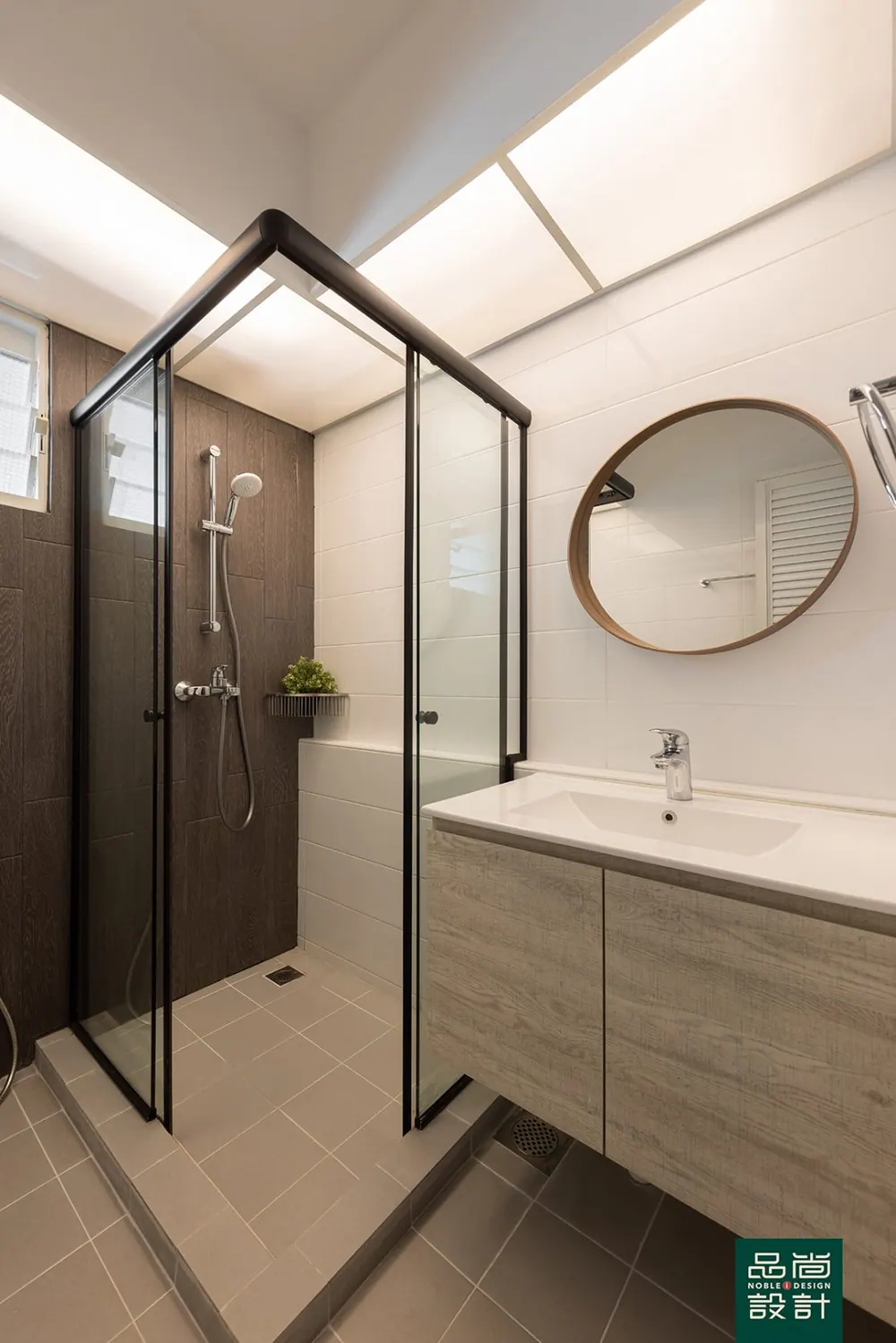
A full strip-out removes tiles, screed and fixtures until the structural slab is exposed, then rebuilds the floor as a system. HDB's re-screeding method on its ceiling leaks page sets out the sequence a planned rebuild follows: hack approximately 25mm deeper around pipes, clear all loose particles, fill around the pipe with non-shrink grout, apply a membrane upturned to 150mm against walls, kerbs and pipes, then lay a waterproof screed of at least 20mm to a gentle gradient.
Thickness governs everything after demolition. HDB caps total floor finishes and screed at 50mm and caps wall finishes including plaster at 25mm in its building works guidelines, and the surface of an RC wall is not allowed to be hacked to form a key for tiling — spatterdash or an equivalent is used instead. A 20mm falls screed plus a 10mm tile plus adhesive consumes most of that allowance, which is what defeats most requests for a deeply recessed, fully kerbless shower floor in an existing HDB toilet.
Demolition is also time-boxed. HDB's renovation terms state that renovation contractors cannot take more than 3 consecutive days to demolish walls and/or remove wall and/or floor finishes, and restricted works such as cutting tiles are allowed only between 9am and 5pm on weekdays, with general renovations running 9am to 6pm on weekdays and Saturdays and none on Sundays or public holidays. A strip-out therefore concentrates the worst noise into a short window — worth telling the neighbours about before the hacking starts, not after.
Five checks that tell you which route your toilet needs
Pour a bucket of water across the finished floor and watch where it goes. Water that reaches the trap quickly and leaves no standing puddle indicates falls worth keeping, which favours an overlay. Water that stalls in a corner or lingers along the kerb means the gradient is wrong, and no adhesive-bonded tile corrects a gradient.
Tap the floor and the lower part of the wall with a coin or a screwdriver handle. A dull, hollow note across more than a few isolated spots means the existing bed has already lost adhesion; overlaying onto it transfers a known failure upward and hides it.
Measure the height actually available before choosing a tile. HDB's overlay condition allows 13mm for the new finish including adhesive, so measure from the existing tile up to the underside of the door leaf, across to the top of the kerb, and down to the rim of the floor trap grating. A toilet with a flush threshold and a grating already sitting level with the tile has nowhere to put 13mm.
Look at the neighbour's ceiling as well as your own floor. Staining, blistered paint or a damp patch below the toilet points to a failed membrane or a leaking pipe collar, and HDB treats that as joint work: the upper and lower flat owners engage a contractor together, agree the repair method, and split the repair cost. A toilet already leaking downwards needs a strip-out, not a new surface.
Check the age of the block against the layout you actually want. In a block under three years old, HDB does not allow toilet wall or floor finishes provided by HDB or the developer to be replaced, though new floor finishes may be laid over the existing ones using adhesives. Enlarging the room is bounded too — HDB's building works guidelines permit enlargement of a bathroom or toilet only after the first 3 years upon completion of the block, with the extension no more than 600mm wide and 0.6m² in area, usable only as a dry area. HDB's water and sanitary plumbing guidelines also state that holes cannot be hacked on the existing floor slab when a pan is replaced, so a WC rarely travels far from its existing discharge point whatever the budget.
Cost, and when the cheaper answer is the right one
Overlay tiling of a common toilet typically runs while a full hack and rebuild of the same room typically runs. Sanitary ware and glass are usually priced separately, at.
For a four-year-old flat with sound tiles, correct falls and a dry ceiling below, the honest recommendation is the overlay: it is faster, quieter, cheaper, and it leaves the original membrane undisturbed. A strip-out earns its cost when falls are wrong, when the trap or pipe collars are failing, when the flat below shows staining, when large areas sound hollow, or when the room is being re-planned. Declining a strip-out that the floor genuinely needs is the expensive path, because rework means demolishing tile the homeowner has already paid for once.
Accreditation is worth checking at quotation stage rather than during a dispute. CASE recorded 787 renovation complaints in 2025, down 18.2% from 962 in 2024 (CASE media release, February 2026). CASE also reported that around 97% of 2024's 962 renovation complaints were against contractors that were not CaseTrust-accredited (CASE media release, February 2025). Noble Interior Design Pte. Ltd. is listed in HDB's Directory of Renovation Contractors (DRC Ref: HB-12-5230A, UEN 201722629H) and is CaseTrust-accredited. Under the CaseTrust renovation scheme, an accredited firm caps the initial deposit at 20% of total cost, provides a deposit performance bond, adopts the CaseTrust Standard Renovation Contract, and carries a 12-month workmanship warranty from completion.
- HDB — Important Information on Renovations (3-year restriction, water test, 3 consecutive days, renovation hours, 150kg/m² slab loading)
- HDB — Renovation Guidelines for Building Works (13mm overlay cap, 50mm/25mm thickness caps, spatterdash, toilet enlargement limits)
- HDB — Renovation Guidelines for Water and Sanitary Plumbing Works and Gas Works (no hacking of holes in the existing floor slab for a pan, PUB Licensed Plumber)
- HDB — Home Care Guide: Ceiling Leaks (re-screeding method, joint repair and cost split)
- HDB — Looking for Renovation Contractors (HDB does not endorse nor guarantee the quality of their works)
- Singapore Statutes Online — Housing and Development (Renovation Control) Rules
- HDB — Directory of Renovation Contractors (demerit points system)
- data.gov.sg — Directory of Renovation Contractors dataset
- CASE media release, February 2026 — 2025 complaint statistics
- CASE media release, February 2025 — 2024 renovation complaints and CaseTrust accreditation
- CASE — CaseTrust accreditation for renovation businesses
Tell us the flat and when you get the keys.
You will get a written quotation with every line spelled out. Take it and compare it with anyone.
Get a quote