Bathroom remodelling versus refresh: choosing the right scope
Refresh or full remodel? The waterproofing membrane decides. HDB's 150mm upturn rule, the 13mm overlay limit, the 3-year restriction on new flats, and what each scope can actually fix.
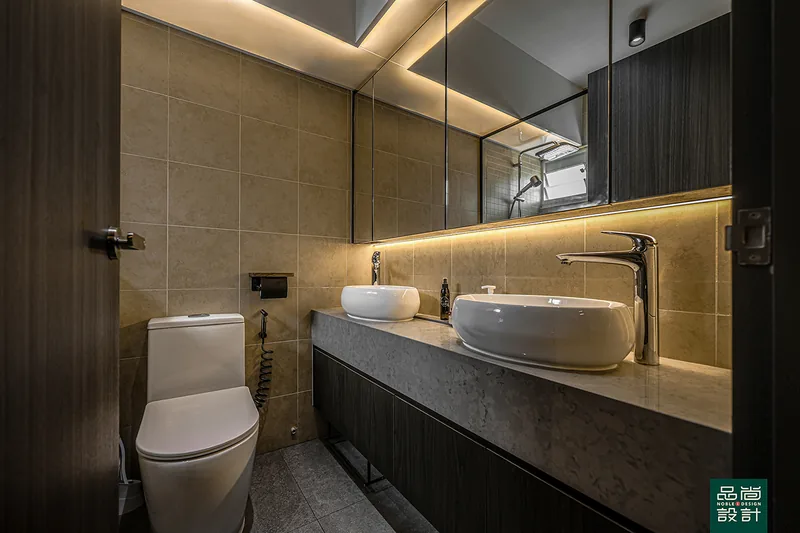
A refresh keeps the existing screed and waterproofing membrane intact and changes only what sits above them: taps, shower set, vanity, mirror, glass screen, door, lighting and paint. A remodel removes the wall and floor finishes, which destroys the membrane underneath and forces new waterproofing, new screed, an HDB permit and a water test before anything goes back. The dividing line between the two scopes is whether the waterproofing layer is disturbed, and duration, disruption and leak risk all follow from that one decision. Anyone comparing bathroom remodeling Singapore quotations should establish which of these scopes is being priced before comparing any totals.
A refresh keeps the existing screed and waterproofing membrane intact and changes only what sits above them: taps, shower set, vanity, mirror, glass screen, door, lighting and paint. A remodel removes the wall and floor finishes, which destroys the membrane underneath and forces new waterproofing, new screed, an HDB permit and a water test before anything goes back. The dividing line between the two scopes is whether the waterproofing layer is disturbed, and duration, disruption and leak risk all follow from that one decision. Anyone comparing bathroom remodeling Singapore quotations should establish which of these scopes is being priced before comparing any totals.
Waterproofing is the line between a refresh and a remodel
An HDB wet area is built in layers: reinforced concrete slab, waterproofing membrane, screed laid to fall towards the floor trap, tile adhesive or mortar bed, then tile. The membrane is the only layer stopping water from reaching the ceiling of the flat below, and it is invisible once the screed goes over it. Every scope decision in a bathroom comes down to whether that layer stays sealed or gets rebuilt.
HDB spells out how the rebuild must be done, and the requirement is unusually specific for a residential guideline:
Pre-packed waterproofing screed and waterproofing membrane must be used in bathrooms/ toilets before laying new floor finishes. Membrane should be upturned (minimum 150mm) against the walls, kerbs, and pipes
You and your renovation contractor must conduct a water test on the bathroom/ toilet upon completing the replacement of floor finishes
— Housing & Development Board, Important Information on Renovations
The 150mm upturn is what stops water tracking sideways under the tiles and out through the door threshold or the shared wall. A membrane laid flat across the floor with no upturn will pass a casual inspection and fail later, which is why the water test is written into the guidelines as a joint obligation of homeowner and contractor rather than an optional extra.
What a bathroom refresh can and cannot fix
A bathroom refresh handles everything that bolts on. Taps and mixers, shower sets, WC seats and cistern parts, vanity units, mirrors, towel rails, ceiling and lighting, a new glass screen, a new door, repainting, regrouting and re-siliconing all sit above the tile line. Most of that list is a fittings-level swap, but HDB's water and sanitary plumbing guidelines state that installing, fixing, replacing or removing a toilet pan (WC), and sealing up the discharge pipe, shall be carried out by a PUB Licensed Plumber.
Overlay tiling extends a refresh one step further, within a defined ceiling. HDB permits laying floor finishes over existing floor finishes using adhesive only where there is only 1 layer of existing floor finishes including cement screed, where the thickness of the floor finishes inclusive of the adhesive does not exceed 13mm, where no tampering of the floor trap is allowed, and where the work does not result in backflow or lateral seepage into the bedroom. A floor that already carries two layers, or one whose fall to the trap is wrong, is outside that route.
A refresh cannot correct anything below the tile. Ponding in the corner furthest from the trap is a screed fall problem. A damp patch on the neighbour's ceiling is a membrane problem. Relocating the WC is a drainage problem, and HDB is explicit that holes cannot be hacked on the existing floor slab.
What a full bathroom remodel involves on site
Strip-out removes wall tiles, floor tiles, the tile bed and the old screed, exposing the slab. Replacement of existing bathroom or toilet floor and wall finishes after the first 3 years from the date of completion of the block requires a permit, and HDB's building works guidelines cap the total thickness of finishes and screed at 50mm for the floor and the total thickness of wall finishes including plaster at 25mm. Both dimensions set the whole build-up: kerb heights, threshold detail, door undercut and shower gradient are all designed inside them.
Rebuilding runs in a fixed order. Pre-packed waterproofing screed and membrane go down with the 150mm upturn against walls, kerbs and pipes, a UPVC floor trap grating with a long collar is used at the floor traps, the water test is carried out, and only then does tiling start. Sanitary ware, screen and joinery follow the tiles. Skipping the test to keep the tiler on programme is the single most expensive shortcut available in a wet area.
Several small rules shape the finished room more than most homeowners expect. Construction of a cement mortar kerb in a bathroom or toilet needs no permit where it does not exceed 100mm in height and 100mm in width. Enlargement of a bathroom or toilet is permitted after the first 3 years upon completion of the block, with the width and area of extension not more than 600mm and 0.6m² respectively, usable only as a dry area. A long bath must keep the void underneath, with an inspection opening and weep holes provided, and a ready-made spa pool is capped at a total weight of 400kg inclusive of the pool, water, motor and other accessories.
Electrical scope is tighter here than anywhere else in the flat. HDB's electrical works guidelines state that power points should not be installed within bathrooms or toilets, which are classified as a wet area under Singapore Standard SS 638, and that an exhaust fan may be installed only in bathrooms and not at other locations such as the kitchen, service yard, balcony or bedrooms.
The rules that make the decision for you
New flats remove the choice for three years. HDB's MyNiceHome renovation guide states plainly:
If you have a newly built BTO flat, you will have to wait 3 years before removing any wall or floor finishes in the toilets. This is to prevent damage to the waterproofing in these wet areas.
— HDB MyNiceHome, HDB Renovation Guide
Within that window the only available scope is a refresh, and the guide points owners towards overlaying the original tiles rather than hacking them away. Owners of resale flats face no such restriction but inherit an unknown membrane age, which usually argues for opening up rather than tiling over when there is any leak history.
Engagement rules apply to either scope. The Housing and Development (Renovation Control) Rules require a flat owner to engage a contractor listed in HDB's Directory of Renovation Contractors, with a fine of up to S$5,000 on conviction, and Rule 6 also makes it an offence for an unregistered person to advertise as a registered renovation contractor, as set out in the subsidiary legislation.
Choosing the scope honestly
A refresh is the right answer more often than a sales conversation suggests. Sound tiles, a dry ceiling in the unit below, water that reaches the trap without pooling, and a complaint that is really about dated colours and corroded chrome all point to fittings and finishes. The room closes for days rather than weeks, no membrane is put at risk, and the money buys visible change.
A full bathroom remodel earns its cost when the failure is structural to the room: standing water after every shower, hollow-sounding or lifting tiles, efflorescence at the grout lines, a stain spreading on the neighbour's ceiling, a WC or basin in the wrong place, or a step-over kerb that no longer suits an ageing occupant. Level-entry showers in particular need the strip-out, because the fall has to be built into a screed sitting inside HDB's 50mm limit on the total thickness of floor finishes and screed. Budget.
Contract terms that matter more in bathroom works
Latent defects make warranty length the decisive commercial term. Under the CaseTrust accreditation scheme for renovation businesses, accredited firms provide homeowners a workmanship warranty for a period of 12 months from the completion date of the works, cap initial deposits at a maximum 20% of the total cost, and must purchase a deposit performance bond. Noble Interior Design Pte. Ltd. is listed in HDB's Directory of Renovation Contractors (DRC Ref: HB-12-5230A, UEN 201722629H) and is CaseTrust-accredited.
Accreditation also correlates with where complaints land. CASE reported that approximately 97% of the 962 renovation complaints it received in 2024 were against non-CaseTrust-accredited contractors, according to its February 2025 media release.
If a dispute cannot be settled, the Small Claims Tribunals are the usual venue for renovation claims, with a prescribed limit of $20,000 and an extended limit of $30,000 where both parties agree, under section 2 of the Small Claims Tribunals Act 1984. Keeping written variation orders, dated site photographs of the membrane before it is screeded over, and the water test result turns an argument about workmanship into a matter of evidence.
- HDB — Important Information on Renovations
- HDB — Renovation Guidelines for Building Works
- HDB — Renovation Guidelines for Water and Sanitary Plumbing Works and Gas Works
- HDB — Renovation Guidelines for Electrical Works
- HDB MyNiceHome — HDB Renovation Guide
- Singapore Statutes Online — Housing and Development (Renovation Control) Rules
- CASE — CaseTrust Accreditation for Renovation Businesses
- CASE — Media release, February 2025 (2024 complaint statistics)
- Singapore Statutes Online — Small Claims Tribunals Act 1984
Tell us the flat and when you get the keys.
You will get a written quotation with every line spelled out. Take it and compare it with anyone.
Get a quote