Bathroom remodeling in Singapore: what drives the cost of an average remodel
No Singapore agency publishes an average bathroom remodel cost, and the nearest official series tracks S&CC rebates. The four decisions that actually drive a bathroom remodelling budget: overlay or strip-out, waterproofing, whether fittings move, and the type of flat.
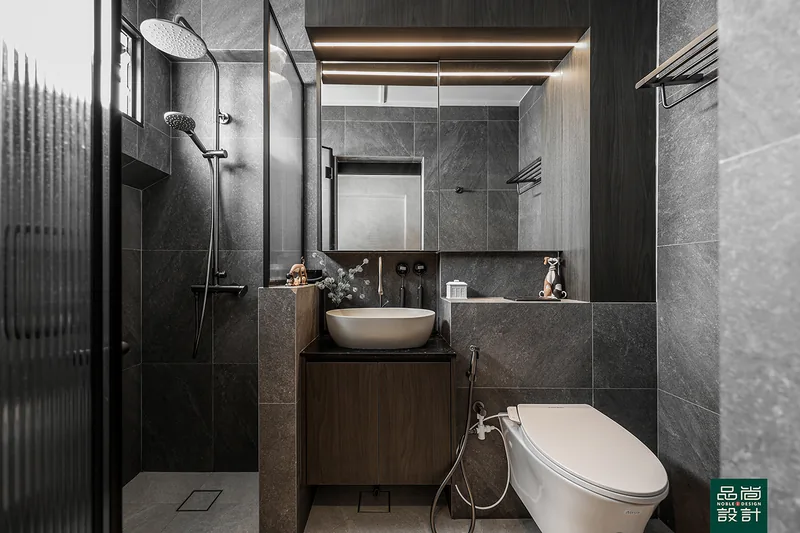
No Singapore government agency publishes an average bathroom remodel cost, and the nearest official statistic measures something else entirely. What actually drives the number is a short list of decisions: whether the old tiles are overlaid or stripped out, whether the waterproofing is renewed and tested, whether the toilet pan, floor trap and water points move, and what kind of flat the bathroom sits in. Two bathrooms of identical floor area can produce quotations that are not comparable at all, because the documents describe different scopes rather than different prices.
- There is no official average, and the nearest official figure measures something else
- Driver one: overlay or strip out
- Driver two: waterproofing, and the test that proves it worked
- Driver three: whether anything moves
- Driver four: what the flat actually is
- Why two quotations for the same bathroom are not comparable
- Build your own number instead of borrowing an average
No Singapore government agency publishes an average bathroom remodel cost, and the nearest official statistic measures something else entirely. What actually drives the number is a short list of decisions: whether the old tiles are overlaid or stripped out, whether the waterproofing is renewed and tested, whether the toilet pan, floor trap and water points move, and what kind of flat the bathroom sits in. Two bathrooms of identical floor area can produce quotations that are not comparable at all, because the documents describe different scopes rather than different prices.
There is no official average, and the nearest official figure measures something else
The phrase "average bathroom remodel cost Singapore" is searched constantly, and the honest answer is that no public register, ministry or statutory board publishes such a figure. Singapore's Department of Statistics compiles a Consumer Price Index, not a renovation price index, and its January 2026 CPI release explains what the closest-sounding component actually contains:
Accommodation, one of the groups in the Housing & Utilities expenditure division of the CPI, comprises 'Actual Rentals for Housing', 'Imputed Rentals for Housing', as well as 'Housing Maintenance & Repairs'. [...] As for the CPI for 'Housing Maintenance & Repairs', it takes into account the rebates for Service & Conservancy Charges (S&CC) disbursed to households living in Housing and Development Board (HDB) flats in the applicable months.
— Department of Statistics Singapore, Singapore Consumer Price Index (2024 as Base Year), January 2026
An index that moves with S&CC rebates is not tracking tiling rates, sanitary ware or waterproofing labour, and the Department of Statistics explains its own data on that basis. Any average circulating elsewhere is drawn from a sample nobody can inspect, covering scopes nobody has defined, which is why a single headline figure is worth less than a scope list a reader can price line by line.
Driver one: overlay or strip out
The largest fork in a bathroom budget is whether the existing tiles stay. HDB's renovation guide states the rule for new flats plainly:
If you have a newly built BTO flat, you will have to wait 3 years before removing any wall or floor finishes in the toilets. This is to prevent damage to the waterproofing in these wet areas. Instead of hacking away the original tiles, you can overlay them with tiles of your choice. If you decide to change the flooring or wall finishes or extend your bathroom/ toilet after this 3-year period, you will need to get a permit from HDB.
— HDB, MyNiceHome renovation guide
Overlaying removes several cost centres at once: no hacking labour, no debris haulage, no disposal, no new screed bed and no re-waterproofing. Overlaying also adds height, so door clearance, the threshold at the entrance, and the fall towards the floor trap all have to be re-checked, and bonding new tile to a glazed surface needs mechanical preparation and a suitable adhesive rather than ordinary cement.
Stripping out is the honest choice where the substrate is suspect, where the layout changes, or where the flat is old enough that the original membrane has reached the end of its service life. The same HDB guide states that a permit is required to remove existing floor finishes and replace them, and that a permit is also required to raise the level of the floors in a kitchen, balcony, bathroom or toilet, because badly executed works of that kind add stress to the floor slab.
Driver two: waterproofing, and the test that proves it worked
Waterproofing is a small share of a bathroom quotation and the entire risk of one. A complete job means a membrane over the slab, an upturn carried up the walls to an agreed height, a protection screed laid over the membrane before tiling, and a water ponding test held long enough to show no loss before anything is covered.
The consequence of skipping it lands on the flat below, and the bill is shared rather than absorbed by the contractor. HDB's home care guidance on ceiling leaks states that flat owners "are responsible for the upkeep and maintenance of your respective flats, including the floor and ceiling slabs", and that if those slabs need repair to resolve a leak, "you and your neighbours will have to arrange for the repair work and split the costs involved". A leak traced to a bathroom renovation therefore becomes a negotiation between two households over cause, method and money, long after the contractor's warranty conversation has gone quiet.
Driver three: whether anything moves
A bathroom that keeps every fitting where it is costs a fraction of one that rearranges them. Moving a toilet pan means re-running a soil pipe within the available fall, moving a floor trap means opening and re-forming the screed and re-testing the waterproofing, and moving a basin or shower mixer means chasing walls for new supply and drainage runs.
Licensing follows the pipe rather than the tile. HDB's guidance for water, sanitary plumbing and gas works states that installing, fixing, replacing or removing a toilet pan and sealing up the discharge pipe "shall be carried out by a PUB Licensed Plumber", so a quotation that shows relocation without naming a licensed plumber is describing work it is not entitled to do. Concealed pipework looks better and costs more, because it is either chased into walls where that is permitted or hidden behind a stud false wall that quietly eats floor area from a room that had none to spare.
Driver four: what the flat actually is
A new BTO flat starts with usable finishes and the three-year restriction above, so remodelling usually means overlaying, replacing sanitary ware and adding a shower screen. A resale flat starts with unknown pipe condition behind the tiles, which is why a resale bathroom budget should carry a contingency that a BTO bathroom budget does not need.
A condominium bathroom sits under a different rulebook entirely. Approvals, permitted working hours and deposit requirements come from the MCST's house rules and the managing agent rather than from HDB, so the sequence and the schedule have to be read from the management office before a programme is written rather than assumed from HDB practice.
Why two quotations for the same bathroom are not comparable
Scope omissions, not rates, explain most of the gap between two documents. Hacking and disposal, hoarding and lift-lobby protection, sanitary ware supplied by the contractor or by the owner, shower screen type and glass thickness, false ceiling with or without an access panel, tile size and the wastage that a large-format tile forces, grout type, and the bathroom door and its frame each appear in one quotation and vanish from another.
Tile size deserves particular attention because it changes several lines at once. A large-format tile needs a flatter substrate, more adhesive, more careful cutting and produces more offcut waste, so the same tile budget buys a different amount of work depending on the format chosen.
Build your own number instead of borrowing an average
Fix the scope in writing first, in the order that the work happens: strip out or overlay, waterproofing and testing, screed and falls, tiling, sanitary ware, glass, ceiling, electrical points and door. Then send that one document to three contractors and require itemised pricing against it, so the comparison is between prices for identical work rather than between guesses at what each firm intended to include.
Payment structure matters more than the total. CaseTrust's accreditation scheme caps initial deposits at a maximum of 20% of the total cost, requires payments to be collected in phases upon agreed milestones and requires a workmanship warranty of 12 months from the completion date of the works, which is a reasonable structure to ask for from any contractor. CASE recorded 787 complaints against renovation contractors in 2025 and prepayment losses of $190,667 in that industry, down 73.8 per cent from $728,813.76 in 2024, in its media release of 9 February 2026, a reminder that money paid ahead of work is the part of a bathroom remodel that is hardest to recover.
- Department of Statistics Singapore — Singapore Consumer Price Index, January 2026
- Department of Statistics Singapore — Consumer Price Index, Our Data Explained
- MyNiceHome — HDB Renovation Guide
- HDB — Home Care Guide, Ceiling Leaks
- HDB — Renovation Guidelines for Water and Sanitary Plumbing Works and Gas Works
- CASE — CaseTrust accreditation for renovation businesses
- CASE media release, 9 February 2026
Tell us the flat and when you get the keys.
You will get a written quotation with every line spelled out. Take it and compare it with anyone.
Get a quote