Aircon installation and trunking in a Singapore HDB renovation
HDB's rules for aircon installation in Singapore flats — BCA-trained installer, running-current and weight caps, the 50mm x 50mm facade opening, condensate to a floor trap — and how they set the trunking route.
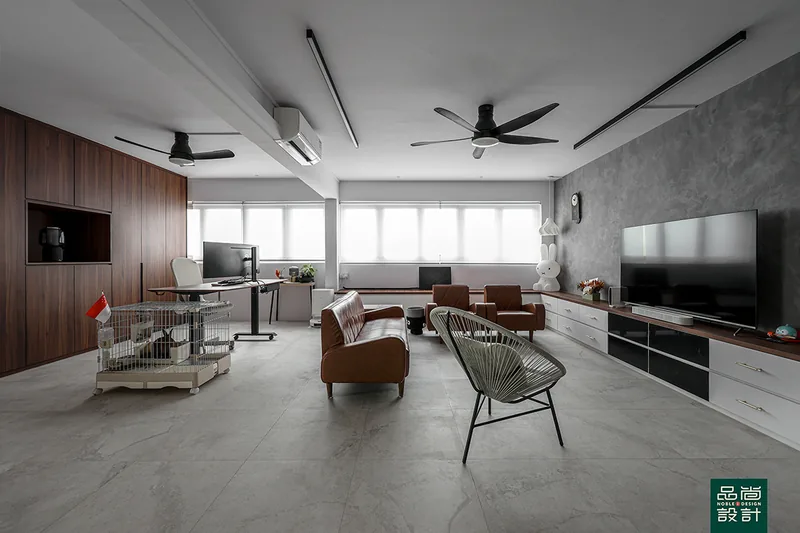
HDB requires air-conditioners in flats to be installed by a BCA trained air conditioning condensing unit installer, and requires an installation report to be submitted to the HDB Branch managing the flat within 14 days after installation. All refrigerant piping must run internally, must not be embedded in reinforced concrete slabs, columns or beams, and condensation water must discharge into a nearby floor trap inside the flat. Those three rules, plus the running-current cap tied to the flat's main switch, decide the trunking route and how much ceiling height a room loses.
- Who is allowed to do aircon installation in a Singapore HDB flat
- Electrical loading: the number that decides how many units you can run
- Trunking: where the pipes actually go
- Sequence: when the aircon work happens in a renovation
- The ledge, the neighbours and the conditions that follow you
- Choosing the unit: what changed with MEPS in April 2025
Aircon installation in Singapore is governed less by the brand of the unit than by three HDB rules that decide the route: piping runs internally, pipe is never embedded in structural concrete, and condensate discharges to a floor trap inside the flat. Those three rules dictate where the trunking goes, how much ceiling height a bedroom loses, and which wall the fan coil unit can sit on. Settling the route before the ceiling frame goes up is the difference between a clean job and a bulkhead added as an afterthought.
Who is allowed to do aircon installation in a Singapore HDB flat
Installer qualification is not a preference the homeowner can waive:
"Air conditioners must be installed by a BCA trained air conditioning condensing unit installer." — HDB, Renovation Guidelines for Air Conditioner Installation Works
Two more parties are involved on paper. HDB requires the flat owner to ensure the electrical installation is carried out by an Energy Market Authority licensed contractor, and requires SP Services Ltd Form CS/5H, endorsed by HDB, to be submitted to SPSL for testing of any new wiring (HDB, Renovation Guidelines for Electrical Works). HDB also requires an installation report to be submitted to the HDB Branch managing the flat within 14 days after installation.
Contractor registration sits above all of it. Under the Housing and Development (Renovation Control) Rules an HDB flat owner must engage a contractor listed in HDB's Directory of Renovation Contractors, and contravention is an offence carrying a fine not exceeding S$5,000 (Singapore Statutes Online). HDB also operates a demerit point system under which a registered contractor accumulating at least 24 demerit points within 24 months is delisted from the Directory (HDB).
Electrical loading: the number that decides how many units you can run
Flats built to an older standard are capped tightly. For flats provided with a 30 amps main switch, HDB sets the maximum total running current for air-conditioning at 5.00 amps in 1- and 2-room flats, 8.50 amps in 3-, 4- and 5-room flats, Executive Maisonettes, Multi-Generation flats and Executive Apartments with 4 bedrooms, and 11.00 amps in an Executive Apartment with 5 bedrooms in a converted block, with a maximum allowed condensing unit weight of 80kg (HDB, Renovation Guidelines for Air Conditioner Installation Works).
Flats on a 40 amps main switch, and flats upgraded under the Main Upgrading Programme or Home Improvement Programme, are treated differently. HDB allows a maximum of 2 split-type condensing units in those flats, restricts the running current with a 20 amps double pole isolator or a 15 amps power point, allows a maximum weight of 110kg per wall panel whether the unit sits on the external wall or the ledge, and permits only 1 condensing unit per wall panel for wall-mounted installations.
Permit exposure follows the main switch rather than the unit. HDB requires an electrical permit for a new 15 amps power point or 20 amps isolator in a flat with a 30 amps main switch, while the same work needs no permit in a 40 amps or MUP/HIP flat; a 20 amps isolator is only allowed for air-conditioner installation in either case (HDB, Renovation Guidelines for Electrical Works). Verifying the total running current of the proposed system against that ceiling is a short check against the manufacturer's spec sheet, and it is the check most often skipped when a homeowner moves from one unit to a multi-split system.
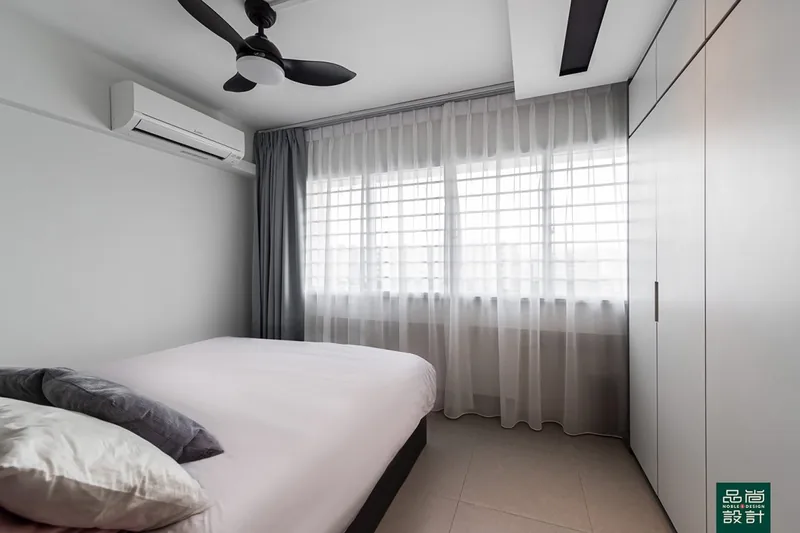
Trunking: where the pipes actually go
Every fan coil unit needs three services back to the condensing unit or the trap: an insulated refrigerant pair, a condensate drain, and control wiring. HDB's constraints on that run are explicit:
"All piping for the air-conditioner must be run internally
Air conditioner pipe must not be embedded in reinforced concrete slabs, columns or beams
Condensation water must be properly discharged into a nearby floor trap in your flat"
— HDB, Renovation Guidelines for Air Conditioner Installation Works
Wall penetrations have a size limit on modern facades. HDB permits a single opening of 50mm x 50mm per panel for the running of refrigerant pipe through a pre-cast facade with tiles, requires the installer to check the wall tiles surrounding the opening for bolts and refrigerant pipes, and requires any delaminated tiles to be removed; hacking of holes or openings through existing reinforced concrete structures within the unit is not allowed.
Trunking size is set by the drain, not by the refrigerant pipe. A condensate line has to fall continuously along its whole length to the floor trap, so a long run across a living room either eats ceiling height at the fan coil end or forces a condensate pump, and a pump is a moving part with a service life that a gravity fall does not have. Where a gas pipe passes through the living room, HDB requires a licensed gas service technician to check that the gas pipes and installation comply with Code of Practice 51, clause 7.2.7, "pipes in enclosed or unventilated areas", before the installation proceeds.
Sequence: when the aircon work happens in a renovation
First fix comes before boards and before tiling. Refrigerant pipe, drain, drain insulation and control wiring are installed while the ceiling is still open, pressure-tested and left under holding pressure, and only then closed in. Second fix — hanging the fan coil units, mounting the condensing unit, vacuuming and charging the system — happens near the end, after painting, so that new units are not sitting in plaster dust for weeks.
Closing a ceiling before the holding test is the classic sequencing failure on a flat renovation. A brazed joint that weeps slowly shows up as a system that cools poorly a few months later, by which point the leak is behind a boarded bulkhead and the repair means cutting and making good. Insisting on seeing pressure held on a gauge before boards go up costs nothing on the day.
Access panels belong in the drawing, not in the argument afterwards. Every fan coil unit, every drain junction and every isolator wants a panel in front of it, and HDB puts the burden of getting back in on the owner: flat owners are responsible for the removal and reinstatement of false ceilings for inspection and maintenance (HDB, Renovation Guidelines for Building Works).
The ledge, the neighbours and the conditions that follow you
Ledge use is restricted by HDB and enforced by the Town Council:
"The air conditioner ledge is to be used strictly for placing the air condensing unit only." — HDB, Renovation Guidelines for Air Conditioner Installation Works
Vibration and staining are treated as the owner's problem indefinitely. HDB requires rubber padding at the base of the condensing unit, requires that condensing units must not cause any vibration in the building, requires the external wall face to be kept free from stains at all times at the owner's expense, and states that where a nuisance is not attended to, HDB will ask the owner to stop using or to remove the condensing unit. Town Council conditions add that the ledge must not be tampered with, must be kept clean and free of obstruction at all times, and must be accessible to HDB, the Town Council and other authorities for checks.
Choosing the unit: what changed with MEPS in April 2025
Efficiency floors moved recently and they narrow the model list. NEA raised the Minimum Energy Performance Standards for single-split air-conditioners to 4-tick and for multi-split air-conditioners to 5-tick on 1 Apr 2025, after raising MEPS for split-type air-conditioners by seven per cent within the 2-tick level on 1 Jan 2022 (NEA, Mandatory Energy Labelling Scheme and MEPS). Checking the shortlisted condensing unit's dimensions and weight against the 80kg or 110kg limit for the flat type, before ordering, avoids the awkward discovery that the compliant model does not fit the ledge.
Fewer, larger indoor units usually beat one head per room. Each additional fan coil unit adds a drain that must fall to a trap, a set of pipes to conceal and an access panel, so the shallowest ceiling is the one serving the fewest heads that still cools the rooms in use.
Paper protects the parts of this work that are invisible after handover. A CaseTrust-accredited renovation business must adopt the CaseTrust Standard Renovation Contract, cap the initial deposit at a maximum of 20% of the total cost, and provide a workmanship warranty of 12 months from the completion date of the works (CASE). CASE recorded 787 renovation complaints in 2025, down 18.2% from 962 in 2024 (CASE media release). Noble Interior Design Pte. Ltd. is listed in HDB's Directory of Renovation Contractors (DRC Ref: HB-12-5230A, UEN 201722629H) and is CaseTrust-accredited, and any contractor's listing can be verified by UEN or company name in the Directory's open dataset on data.gov.sg.
- HDB — Renovation Guidelines for Air Conditioner Installation Works
- HDB — Renovation Guidelines for Electrical Works
- HDB — Renovation Guidelines for Building Works
- Housing and Development (Renovation Control) Rules — Singapore Statutes Online
- HDB — Directory of Renovation Contractors
- NEA — Mandatory Energy Labelling Scheme and Minimum Energy Performance Standards
- CASE — CaseTrust accreditation for renovation businesses
- CASE media release, February 2026
- data.gov.sg — HDB Directory of Renovation Contractors dataset
Tell us the flat and when you get the keys.
You will get a written quotation with every line spelled out. Take it and compare it with anyone.
Get a quote