Feature Walls in a Singapore Flat: Materials, Fixing and What Dates Badly
Which feature wall finishes need an HDB permit, the 6mm/40mm fastener limit, why cables cannot be chased into the wall, and the details that age badly.
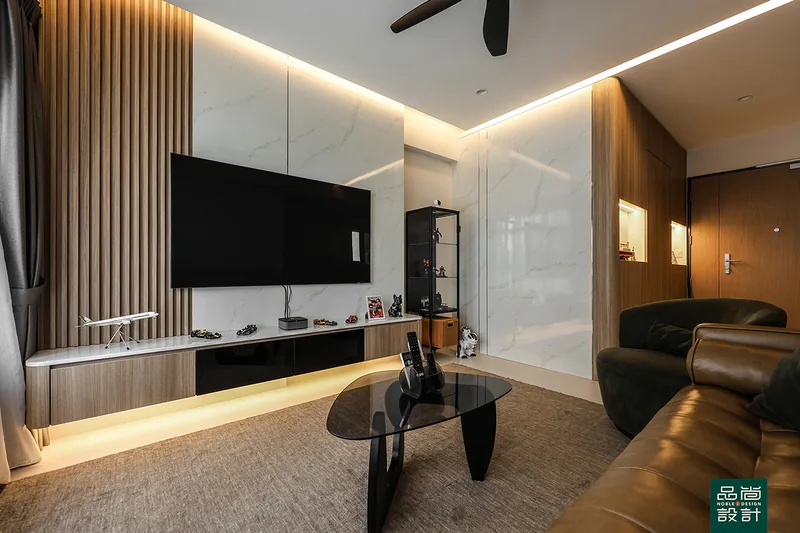
Most feature wall finishes in an HDB flat need no renovation permit — HDB's building works guidelines mark wallpaper, plastering, rock-stone finish, spray painting and solid timber or mirror wall panels as not requiring one (https://www.hdb.gov.sg/managing-my-home/renovation-and-maintenance/renovation/renovation-guidelines/building-works). Three limits decide whether the wall is legal and whether it lasts: fasteners must not exceed 6mm in diameter and 40mm in penetration depth, finishes laid over existing finishes with adhesive must not exceed 13mm and must not form a third layer, and the concrete surface must not be hacked to form a key for tiling. Electrical cable cannot be embedded in a reinforced concrete wall or in wall plaster, so a media wall needs a built service void rather than a chase. What dates a feature wall is rarely the material but the fixed geometry around it — a niche sized to one television, a cove that takes one proprietary LED strip, a colour matched to one sofa.
Does a feature wall need an HDB renovation permit?
Most feature wall finishes do not need one. HDB's renovation guidelines for building works list wallpaper, cement and sand plastering, gypsum plastering, rock-stone finish and spray painting under wall finishes with permit required marked as No, attaching a single condition — pre-packed material must be used for plastering (HDB Renovation Guidelines for Building Works). Solid timber and mirror panels sit in the same table with no permit required, subject to a fastener limit rather than a thickness limit.
Two neighbouring rows in that table change the answer for anyone tiling or cladding. Laying finishes over existing finishes using adhesives needs no permit, but HDB attaches three conditions — no tampering of existing structures and finishes, a thickness not exceeding 13mm, and no laying of a third layer (HDB Renovation Guidelines for Building Works). Replacement of internal wall finishes up to ceiling level does require a permit, and HDB caps the total thickness including plaster at 25mm.
Preparing bare concrete for tile or stone is where an inexperienced crew breaks a rule without noticing. HDB's conditions for laying finishes on the bare concrete surface it provides are explicit:
Surface of RC wall is not allowed to be hacked to form key for tiling
Spatterdash or other equivalent shall be used to form key for tiling
— HDB, Renovation Guidelines for Building Works, laying of wall finishes on bare concrete surface provided by HDB
What the finish is actually stuck to
Four substrates cover almost every feature panel in a Singapore flat, and each behaves differently. A reinforced concrete surface is flattest and strongest, but cannot be hacked to form a key and accepts only shallow fixings. A hollow block or glass block partition can be erected without a permit, subject to HDB's condition that only one layer of 63mm hollow block or 80mm thick glass block can be erected (HDB Renovation Guidelines for Building Works). A gypsum partition on metal stud also needs no permit and carries the same fastener condition as timber and mirror panels, while a plywood or MDF carcass on battens is joinery, and its flatness belongs to the carpenter.
Flatness separates a slab-clad plane that reads as one surface from one that catches light in ripples. Large-format porcelain and sintered stone amplify substrate deviation because the eye follows a reflected line across the sheet, while matt microcement and fluted panelling forgive it. Have the substrate checked with a long straightedge before any finish goes on, and put the flatness tolerance in the quotation.
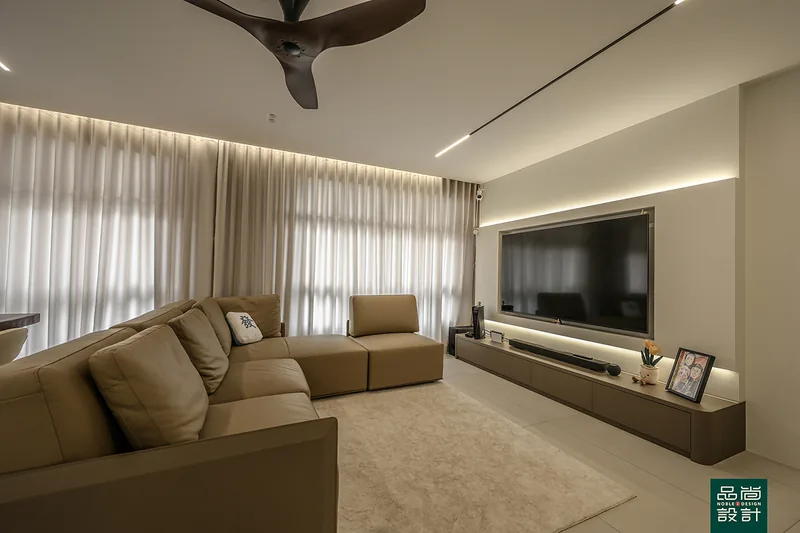
Fixing: the 6mm and 40mm limit
HDB attaches the same fastener condition to solid timber and mirror panels, to gypsum partitions, and to false ceilings:
All fasteners/ connectors (e.g. screws, nails, bolts, etc.) used must not exceed 6mm in diameter and 40mm in penetration depth
— HDB, Renovation Guidelines for Building Works
Design consequences follow directly from that limit. A heavy stone or sintered-stone slab cannot hang off deep chemical anchors in an HDB flat, so its weight has to bear on the floor, or on a frame that bears on the floor, with the fixings resisting overturning only. A wall-hung television, a floating shelf or a cantilevered bench must land on a batten or stud grid designed for the load, never on a plug in thin plasterboard. Ask what each panel is hanging on, because "it's screwed on" is not a specification.
Drilling carries a second constraint in flats with concealed wiring. HDB's electrical guidelines point to Drawing 1, "Drilling of Holes in Flats with Concealed Electrical Wiring", and require precautionary measures so that anchors, including hammering of nails, are located away from the concealed conduits shown on the concealed conduit layout plans (HDB Renovation Guidelines for Electrical Works). Getting hold of those plans before bracket positions are fixed prevents a drilled cable.
Noisy preparation has a clock on it. HDB states that a renovation contractor can only use 2 handheld power tools approved by HDB or their equivalent at a given time, and that neighbours staying within a radius of 2 units should be informed at least 5 days in advance, with written notice, before renovations begin (HDB, Important Information on Renovations). Noisy work such as cutting of tiles is confined to 9am to 5pm on weekdays, while general renovations run 9am to 6pm on weekdays and Saturdays, with none on Sundays or public holidays.
Concealed cables behind a media wall
A cable chase cut into concrete and plastered over is the most common illegal detail behind a television panel. HDB's technical terms and conditions for electrical works state:
Embedding or wiring housed in metal/ high impact PVC conduit in reinforced concrete (RC) slabs, beam, column, wall and in wall plaster or other finishes is not allowed
— HDB, Renovation Guidelines for Electrical Works
Legal routes exist and they build a better result anyway. Frame the panel with a service void, fit brush plates at desk and screen height, and leave one panel demountable so cables can be pulled again when the television changes. HDB's guidelines separately list covering of wiring with PVC trunking and encasement of surface wiring in metal or high impact PVC conduit. Any additional lighting point or 13-amp power point must be wired by an EMA licensed electrical worker, and SP Services Ltd Form CS/5H, endorsed by HDB, is submitted for testing of the new wiring.
Keeping that void accessible pays off later. HDB puts the limited life span of a flat's electrical wiring at an average of 25 years for PVC electrical cables, and advises replacement when the life-span is over or conditions have deteriorated (HDB Renovation Guidelines for Electrical Works). A resale flat clad in glued-on panelling turns rewiring into demolition.
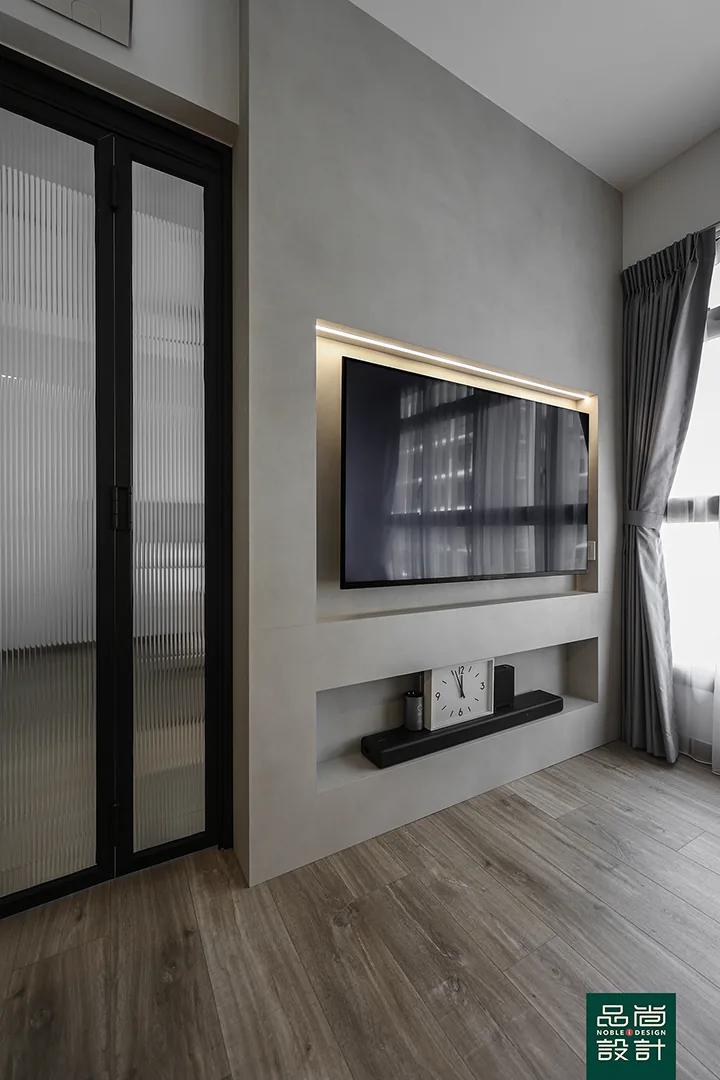
Why feature walls fail
Adhesive-only overlays fail at the bond line. Painted, powdery or hollow-sounding tile is not a substrate, and tapping the whole surface with a coin beforehand costs nothing.
Junctions between dissimilar materials crack. HDB's Home Care Guide is direct about the mechanism:
Different materials expand and contract with temperature changes. Over time, this differential movement will result in cracks along the joints
— HDB Home Care Guide, Walls
Detailing a junction as a shadow gap or a metal trim, rather than one continuous skim, is what keeps such movement invisible. A seamless microcement run carried across a block-to-concrete joint will telegraph the joint underneath it.
Moisture kills the wrong material in the wrong place. An MDF-core fluted panel taken down to a wet-mopped floor swells along its bottom edge and cannot be repaired, so specify a PVC or aluminium profile at floor level. Mirror fails differently, because solvent-based adhesive attacks the silvering from behind — use a mirror-grade neutral-cure adhesive with mechanical support, and ask for safety backing film.
Paint is now a regulated material. NEA requires that from 1 January 2026 interior paints contain no formaldehyde, defined as less than 0.01 per cent weight for weight in-can (NEA). That rule covers paint only and does not reach the adhesives inside composite wood panels, so if indoor air quality is the reason behind the question, ask separately for the emission class of the boards.
What dates badly, and what ages well
Fixed geometry dates faster than material. A niche sized to today's television, a console welded into the cladding, a light cove that accepts one proprietary LED strip, and a colour matched to one sofa all age at the speed of the object they were built around.
What ages well is dull to describe and pleasant to live with: one material, one plane, joints aligned to the door heads and skirting lines already in the flat, and a finish that can be repaired locally. Paint on a properly prepared surface is often the right answer, because it is cheapest to change and does not eat depth out of a bedroom that is already tight. Cladding earns its place when it solves something specific — covering a genuinely uneven surface, absorbing sound in a room with hard floors, or carrying services that cannot legally be chased in.
What it costs, and who may build it
Price follows substrate preparation, material and the number of trades landing on the same job. Ask for as separate lines, because one lump sum hides which of them was quietly dropped.
The contractor question is not cosmetic. HDB states that a flat owner who did not engage a contractor from the Directory of Renovation Contractors, or who breached HDB's renovation rules and guidelines, faces on conviction a fine of up to $5,000 and other penalties (HDB, Important Information on Renovations), and the Housing and Development (Renovation Control) Rules place that duty on the flat owner (Singapore Statutes Online). CASE recorded 787 complaints against renovation contractors in 2025, down 18.2 per cent from 962 in 2024, with renovation prepayment losses down 73.8 per cent to S$190,667 (CASE media release, February 2026), and roughly 97 per cent of 2024's 962 renovation complaints were against contractors that were not CaseTrust-accredited (CASE media release, February 2025).
Noble Interior Design Pte. Ltd. is listed in HDB's Directory of Renovation Contractors (DRC Ref: HB-12-5230A, UEN 201722629H) and is CaseTrust-accredited. Any firm's listing can be checked against the DRC open dataset by UEN or company name (data.gov.sg), and HDB is explicit that a listing is not an endorsement or guarantee of a contractor's work (HDB, Looking for Renovation Contractors).
- HDB Renovation Guidelines for Building Works (wall finishes, walls, false ceiling tables)
- HDB Renovation Guidelines for Electrical Works
- HDB Important Information on Renovations
- HDB Home Care Guide — Walls
- NEA — No formaldehyde in interior paints from 1 January 2026
- CASE media release, February 2026 (2025 complaint statistics)
- CASE media release, February 2025 (2024 complaint statistics)
- Housing and Development (Renovation Control) Rules
- HDB Directory of Renovation Contractors — open dataset
- HDB — Looking for Renovation Contractors
Tell us the flat and when you get the keys.
You will get a written quotation with every line spelled out. Take it and compare it with anyone.
Get a quote