Muji style interior design in a Singapore flat: how it's built
Muji style interior design in Singapore, built line by line: wood finish, board spec, handleless fronts, lighting, and the HDB rules that apply.
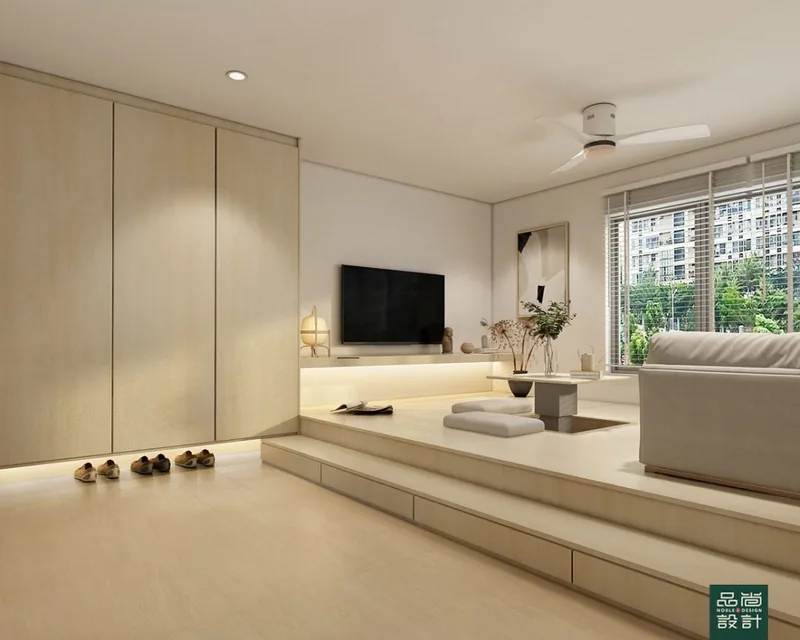
Muji-style interiors in a Singapore flat are built from a very short material list: one pale wood tone, one warm white, matte surfaces throughout, and full-height built-in carpentry that keeps everything out of sight. The look is settled by four carpentry specifications — carcass board, front finish, edge banding and the type of handleless pull — rather than by furniture purchases, and none of it requires buying anything from MUJI. HDB's published renovation guidelines shape it directly too: HDB states on hdb.gov.sg that timber or laminate flooring laid over existing floor finishes must not involve raising the floor as a platform, and that a false ceiling must keep a minimum clearance of 2.4 metres from finished floor level.
- What "Muji style" actually means in an interior design brief
- The material decisions that make or break the look
- How Muji-style carpentry is actually built
- What HDB's rules let you do to the floor, the ceiling and the walls
- Lighting: the same carpentry succeeds at 3000K and fails at 6500K
- Where the money goes in a Muji-style Singapore flat
- Keeping it looking like that in a tropical climate
- The rule, in the regulator's own words
Muji style in a Singapore flat is bought as a mood board and delivered as a carpentry contract. Almost everything that makes the look work — the narrow wood tone, the flat fronts, the missing handles, the empty counter — is settled in a few lines of a quotation, long before anyone is on site. This guide covers those lines, and the HDB rules that decide which of them are possible.
What "Muji style" actually means in an interior design brief
Muji style borrows the design logic of the Japanese retailer MUJI (無印良品) — few materials, no visible branding, natural fibres, pale wood, objects that disappear into use — and applies it to a room rather than to a product. Buying MUJI furniture does not produce the look, and building the look requires nothing from MUJI.
Three rules describe most of Muji style interior design in Singapore: one wood tone, one white, no gloss. A second wood tone, a black handle, or a semi-gloss lacquer will each, on its own, pull a room out of the style.
Muji style is neither Scandinavian nor minimalist, though all three get quoted from the same photograph. Scandinavian design accepts contrast and colour, minimalism reduces the number of visible elements, and Muji style is warmth at low contrast that tolerates open shelves, linen and rattan boxes provided everything shares the palette.
The material decisions that make or break the look
The first material decision in a Muji-style renovation is how you achieve "wood". Pale timber in a Singapore flat comes from wood-grain laminate, real veneer, melamine-faced board, or solid ash and oak. Laminate is the most dimensionally stable in a tropical climate; veneer looks better close up but fades unevenly beside a west-facing window; solid fronts move with humidity and show it at the door edges. The clearest tell of a cheap imitation is a laminate whose grain visibly repeats across adjacent doors, so ask for the pattern repeat length before the doors are pressed.
The second material decision is sheen. Muji style reads matte, and matte is where fingerprints live, so anti-fingerprint matte laminate is worth specifying on every door touched daily.
The third material decision is which white the flat is painted. A warm white with a trace of yellow or grey sits correctly beside pale oak, while a cool blue-leaning white makes the same oak read orange under artificial light. Paint is the cheapest lever in a renovation, so test two large patches at night before committing the flat.
How Muji-style carpentry is actually built
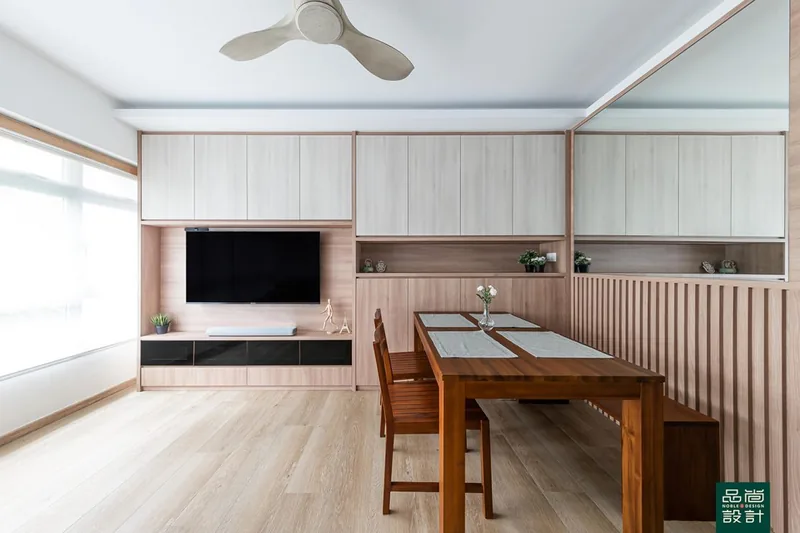
Muji-style carpentry is described by four specifications, and a quotation missing any of them cannot be compared with another. The carcass is the box — plywood, MDF or particleboard, usually 15mm or 18mm, with plywood generally preferred near wet areas. The front is what you see. The edge is the band sealing the front's exposed edge, and on a pale slab door a dark glue line there is the most visible defect in the room, which is why seamless laser or PUR edging is worth naming.
The fourth carpentry specification is the pull, and handleless fronts do not age equally in Singapore's humidity. A routed finger groove and a J-profile aluminium channel have nothing to fail, while a push-to-open latch has a spring and a tolerance, and on a tall wardrobe door it is the detail most likely to need adjustment in year one.
Air quality deserves its own line in a carpentry-heavy flat. From 1 January 2026 NEA requires interior paints sold in Singapore to contain no formaldehyde, with in-can content below 0.01% weight by weight, and that rule covers interior paint rather than the adhesives in composite wood or carpentry (NEA). If low emissions matter, the board's emission grade must be written into the contract, because the paint rule will not cover it.
What HDB's rules let you do to the floor, the ceiling and the walls
The floor is where Muji-style projects most often collide with published guidance. HDB states that laying vinyl, carpet or linoleum needs no permit, that replacing tiled or timber floor finishes does need a permit with the total thickness of floor finishes and screed not exceeding 50mm, and that laying parquet or timber flooring over existing floor finishes must not involve raising the floor as a platform, using cement screed, or hacking out the existing finishes (HDB renovation guidelines: building works).
The raised tatami-style platform in so many Muji reference images is a separate item with its own conditions rather than a banned one. HDB lists installation of a hardwood platform on the floor as work needing no permit, subject to conditions: the void between the timber joists beneath the platform must not be sealed with cement or other materials, no storage is allowed in that void, the sides of the platform must be sealed, a minimum 1m safety barrier height must be maintained from the top of the platform to the window sill or parapet, and the recommended room height is minimally 2.4 metres (HDB). What is not allowed is arriving at the same effect by building the floor finish itself up over the existing finishes.
The ceiling has a hard limit. HDB states that installing a false ceiling needs no permit but must keep a minimum clearance of 2.4 metres from finished floor level — a requirement HDB notes does not apply to toilets and bathrooms — and must use non-combustible materials, enclose no gas pipe, use fasteners into the underside of the concrete slab no larger than 6mm in diameter and 40mm in penetration depth, with flat owners responsible for removing and reinstating the false ceiling for inspection and maintenance (HDB). A deep cove for indirect lighting eats that clearance, so cove depth and ceiling height must be checked against each other on paper.
Walls need approval first. A permit from HDB is required before hacking down or altering any walls in a flat (My Nice Home, HDB), and HDB requires a Professional Engineer for civil or structural works to supervise demolition of non-load-bearing reinforced concrete elements such as partition walls, party walls, stiffeners, lintols or hangers (HDB). That engineer is a real invoice, so settle whether it sits inside the contractor's price before signing.
Bathrooms in a new flat are on a clock. For a newly built BTO flat, owners must wait 3 years before removing any wall or floor finishes in the toilets, and HDB's guide states that instead of hacking away the original tiles you can overlay them with tiles of your choice, with a permit required if you change the flooring or wall finishes after that 3-year period (My Nice Home, HDB). Overlaying lifts the finished floor, so door clearance must be drawn before the tiler starts.
The household shelter is where the ambition of one unbroken wall stops. HDB states that the walls of the household shelter must not be hacked or drilled and that the door must not be tampered with and must be able to be opened and closed properly at all times (My Nice Home, HDB). Any concealment must therefore be carried by adjacent structure and leave the steel door operable.
Noise has fixed windows, and the contractor must be listed. HDB permits general renovation from 9am to 6pm Monday to Saturday with none on Sundays and public holidays, and allows noisy renovation such as demolishing walls or removing wall and floor finishes only from 9am to 5pm Monday to Friday, not on weekends, public holidays or the eve of major public holidays (My Nice Home, HDB); that suits a carpentry-heavy build because the noise concentrates early. Under the Housing and Development (Renovation Control) Rules an HDB flat owner must engage a contractor listed in HDB's Directory of Renovation Contractors, and contravention is an offence carrying a fine not exceeding S$5,000 (Singapore Statutes Online). Noble Interior Design Pte. Ltd. is listed in HDB's Directory of Renovation Contractors (DRC Ref: HB-12-5230A, UEN 201722629H) and is CaseTrust-accredited.
Lighting: the same carpentry succeeds at 3000K and fails at 6500K
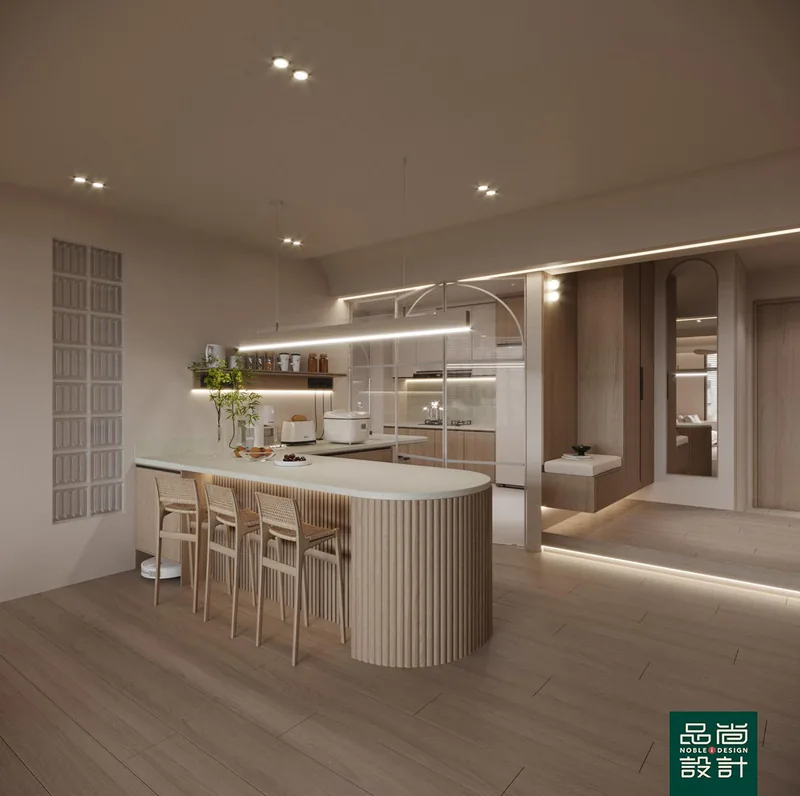
Colour temperature does more damage to a Muji-style Singapore flat than any material choice. Pale wood and warm white are meant to be seen between 2700K and 3000K; under a 6500K daylight tube the same oak reads grey-green and the same wall reads faintly blue. Use one colour temperature throughout, because mixed temperatures across a sight line read as a mistake rather than a scheme, and specify dimmable drivers before the ceiling closes since adding them later is a ceiling job. Placement matters too: a grid of downlights throws scalloped arcs down flat wardrobe fronts, so wall-washing the joinery face gives a flatter result.
Where the money goes in a Muji-style Singapore flat
Carpentry dominates the budget for a structural reason: an empty-looking room is one whose contents have moved into made-to-measure cabinets, and possessions do not shrink because the reference photograph is calm.
No published market average exists for a Muji-style renovation in Singapore, and any figure presented as one is a marketing number. Real ranges come off a real quotation against a real floor plan.
Keeping it looking like that in a tropical climate
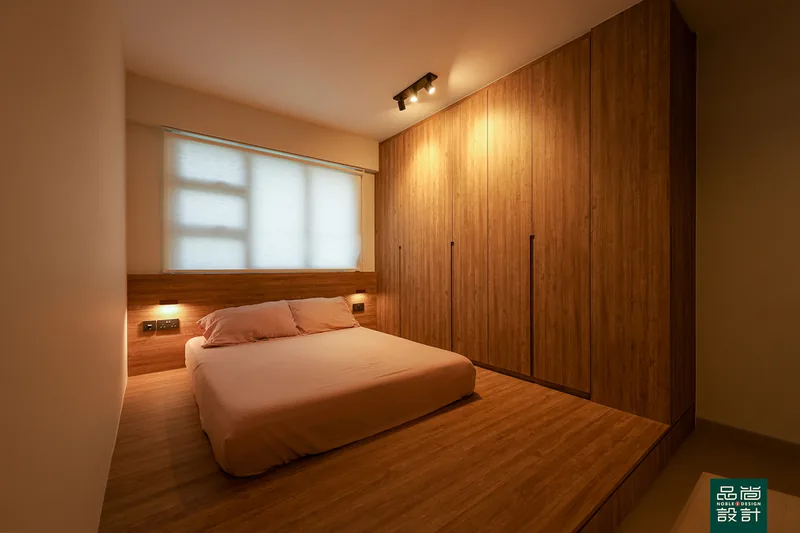
Pale matte surfaces in Singapore have three predictable enemies: skin oil around every pull, dust in every finger groove, and humidity inside closed cabinets sharing a wall with a bathroom. None are defects; all are maintenance.
CaseTrust-accredited renovation businesses must provide a workmanship warranty of 12 months from the completion date of the works (CASE), so establish in writing whether door realignment — the most common first-year carpentry call in a humid flat — falls inside it.
Is Muji style the same as Japandi?
No. Muji style holds a single low-contrast palette of pale wood, warm white and matte surfaces, while Japandi marries Japanese restraint to Scandinavian function and usually adds a darker second wood plus a dark accent metal. A Japandi room can contain black; a Muji-style room generally cannot.
Can I get the look without built-in carpentry?
Partly. Paint, lighting colour temperature, floor tone and textiles carry much of the Muji look cheaply, which is the right first move in a rented home. What freestanding furniture will not give you is the flush, uninterrupted wall of storage that makes the style read as calm rather than sparse.
Does Muji style work in a 3-room HDB flat?
It works well, with one caveat. Pale low-contrast surfaces make a small room feel larger, but the tidiness depends on having somewhere to put things, so a 3-room flat usually needs more of its wall length given to full-height storage than a 5-room flat does.
The rule, in the regulator's own words
From 1 January 2026, NEA requires interior paints sold in Singapore to contain no formaldehyde, with in-can content below 0.01% weight by weight. The rule covers interior PAINT — it does not regulate adhesives in composite wood or carpentry.
— NEA / MSE
The text above is quoted from NEA / MSE joint release; the link goes to the primary source so it can be checked rather than taken on trust.
Tell us the flat and when you get the keys.
You will get a written quotation with every line spelled out. Take it and compare it with anyone.
Get a quote