Singapore interior design trends worth following, and the ones that age badly
Which Singapore interior design trends survive a tropical flat and HDB's rules, which ones age badly, and what each costs to reverse.
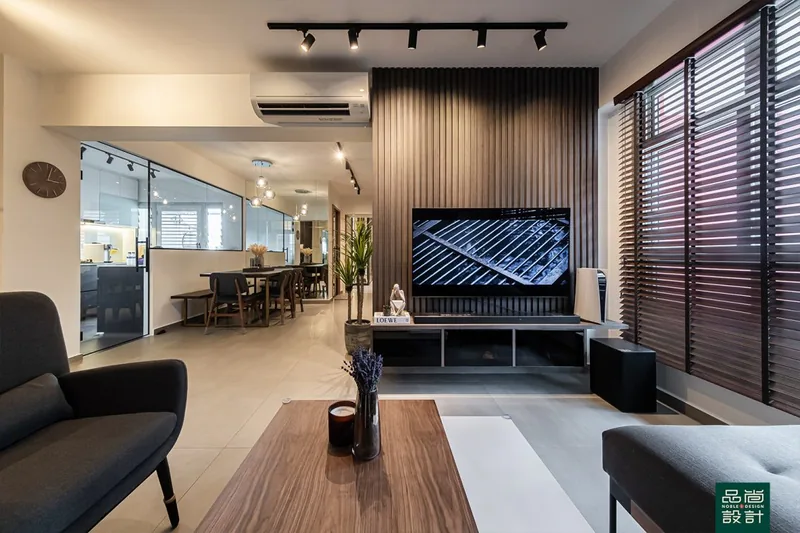
Interior design trends survive in Singapore when they solve a permanent local problem — humidity, storage, small floor plates, service access — and can be reversed cheaply. Trends age badly when they are irreversible commitments: full-perimeter false ceilings, wall-to-wall carpentry that seals services, saturated colour drenched over sprayed joinery, and hacked-open layouts. The Meteorological Service Singapore states that the mean annual relative humidity is around 82%, so material behaviour, not styling, decides how a scheme looks in year five. The practical test before committing to any look is its reversal cost, written next to it on the quotation.
The interior design trends Singapore homeowners meet each January arrive from Pinterest boards and showroom displays, and almost none of them were drawn for a tropical flat with a household shelter in the middle of it. A more useful filter than taste is time: every look runs on three clocks at once — how long it stays fashionable, how long the material survives the climate, and how long the rule behind it stays unchanged. A trend ages badly when the material clock or the regulation clock runs out first.
What "ages badly" actually means, in money
Ageing badly is a reversal cost rather than a matter of opinion. Repainting a room costs paint and access; stripping a fluted feature wall costs demolition, patching and repainting; undoing a hacked-open kitchen costs a permit application, a Professional Engineer, a rebuild and a fresh set of finishes.
The regulatory floor under that arithmetic is public. HDB requires a permit for demolition of non-load bearing reinforced concrete elements such as partition walls, party walls, stiffeners, lintols or hangers, and states that a Professional Engineer for Civil or Structural works is required to supervise the demolition works (HDB renovation guidelines for building works). Writing the reversal cost beside each fashionable item, before signing anything, turns a mood board into a decision.
The material clock: what the climate does to a look
Humidity sets the material clock in Singapore, and the figure is published. The Meteorological Service Singapore states on its Climate of Singapore page that "The mean annual relative humidity is around 82%. Relative humidity frequently reaches 100% during prolonged periods of rain." (Meteorological Service Singapore).
Finishes that depend on a perfectly stable substrate fight that number daily. Mitred veneer joints open, high-gloss lacquer telegraphs every movement in the board beneath it, and unsealed timber near a shower does not forgive. Matte and lightly textured surfaces, honest shadow gaps instead of invisible joints, and moisture-tolerant substrates in wet zones are not timid choices — they are the ones still looking deliberate in year five.
Trends worth following, because each solves a permanent local problem
Layered lighting on separate circuits has outlasted every lighting fashion of the past decade. One bright ceiling fitting forces a room into a single mood, while three switched layers — ambient, task and a low warm layer — let the same living room work at 8am and at 11pm without another renovation.
Ventilation-led planning matters more here than any palette. Keeping a cross-breeze path from the service yard through to the living room window, and refusing to block it with a full-height partition, decides whether a flat runs on fans for much of the year or on compressors.
Low-emission specification is now half law and half homework. From 1 January 2026 NEA requires interior paints sold in Singapore to contain no formaldehyde, with in-can content below 0.01% weight by weight (NEA); that rule covers interior paint and does not reach the adhesives inside composite wood, so board emission class still has to be written into the carpentry section of the quotation rather than assumed from a green-looking brochure.
Storage counted in volume rather than in metres of cabinet frontage is the most reliably satisfying trend in small flats. Photographs reward long uninterrupted joinery runs; daily life rewards a tall broom cupboard, a drawer deep enough for a rice cooker, and one shelf that swallows a full-size suitcase.
Loose furniture wherever the function might change is a quiet hedge. A built-in study desk is a commitment to that room staying a study, and a good desk on legs is not.
Trends that age badly, and the specific reason each one does
Full-perimeter false ceilings with cove lighting are the most common regret in a standard flat, because the ceiling is a service zone before it is a decorative one. HDB sets a minimum clearance height of 2.4 metres from finished floor level for false ceiling installation, not applicable to toilets and bathrooms, requires non-combustible materials, states that no gas pipe is to be enclosed within the false ceiling, and makes flat owners responsible for removal and reinstatement of the false ceilings for inspection and maintenance (HDB). Dropping the ceiling around an entire flat to conceal two air-conditioner pipes buys one photograph and sells headroom, access and cheap future repairs.
Wall-to-wall carpentry that seals services ages badly the first time something leaks. HDB warns that some flat layouts contain enclosed sanitary ducts in the kitchen fitted with a weephole to alert residents of leaks, and that "These weepholes should not be sealed or blocked with kitchen carpentry or other fixtures, so as not to cause damage to your renovations in case of leaks." (HDB). A removable panel costs a fraction of a cabinet run and preserves the option of a cheap repair.
Seamless floor and wall systems age badly when they are drawn before the thickness caps are read. HDB caps total thickness of floor finishes and screed at 50mm and requires a permit to replace floor finishes, and where internal wall finishes are replaced up to ceiling level the total thickness of the wall finishes including plaster must not exceed 25mm, with pre-packed material used for plastering (HDB). Seamless looks are achievable inside those caps; a contractor who has not read them discovers the problem after the substrate is already down.
The hotel bathroom in a standard flat carries the widest gap between render and reality. For a newly built BTO flat, owners must wait 3 years before removing wall or floor finishes in the toilets (My Nice Home, HDB), and enlargement of a bathroom or toilet after the first 3 years upon completion of the block is capped by HDB at a maximum extension width of 600mm and area of 0.6m², usable only as a dry area, with the existing gas riser and its branch pipe not becoming enclosed (HDB). A freestanding tub, a double vanity and a full dry-wet separation rarely all survive those limits.
Colour drenching a single saturated shade across walls, ceiling and joinery photographs beautifully and dates as one set. Paint is cheap to reverse, so the real exposure sits in the sprayed cabinet fronts; ordering joinery in a neutral and putting the fashionable colour on the walls keeps the expensive half of the scheme outside the trend cycle.
Open-plan everything deserves a specific warning in a cooking household. Removing a kitchen wall needs HDB approval, and demolition of non-load bearing reinforced concrete elements must be supervised by a Professional Engineer for Civil or Structural works, while the grease and odour that a door used to contain then reach every soft surface in the flat. Where the household stir-fries, a glass door in the same opening delivers most of the visual gain and none of the smell.
Buying a trend without buying a regret
Split the budget into a permanent half and a replaceable half before choosing anything. Permanent covers wall positions, waterproofing, electrical routes, plumbing points and carcass quality; replaceable covers paint, door fronts, handles, light fittings, textiles and loose furniture. Trend spending belongs in the replaceable half almost every time.
Ask for the fashionable element as its own quotation line so the trade-off stays visible. A line that can be deleted without redrawing the flat is a trend you can afford to tire of.
Warranty length is a useful sanity check on how fast a finish shows its faults. CaseTrust-accredited renovation businesses must provide homeowners a workmanship warranty for a period of 12 months from the completion date of the works (CASE) — the window in which shrinkage cracks, misaligned doors and failed seals tend to surface, which is why every specialist finish is worth photographing at handover.
Disputes over finishes are common enough to design around. CASE received 787 complaints against renovation contractors in 2025, down 18.2% from 962 in 2024 (CASE), and the failure modes behind finish disputes — cracking, delamination, water ingress, colour drift — are exactly what a warranty period exists to catch.
Whoever builds the fashionable detail must still be registered. Under the Housing and Development (Renovation Control) Rules an HDB flat owner must engage a registered renovation contractor, and contravention is an offence carrying a fine not exceeding $5,000 (Singapore Statutes Online).
Do neutral interiors resell better in Singapore?
No reliable published figure supports that claim, so treat it as folklore rather than data. The defensible version is narrower: a scheme a buyer can live with unchanged saves them a renovation, and a highly specific scheme narrows the pool of buyers who feel that way.
How long before a fitted look starts to date?
Fashion cycles are not predictable, and the built-in half of a renovation is normally replaced far later than the styling half. Choosing fronts, handles and paint as the trend layer, and keeping carcasses, wall positions and services neutral, is what allows a flat to be updated in a week instead of gutted.
Which trend is safest to skip entirely?
Anything that hides a service behind a permanent surface — pipes, weepholes, distribution boards, floor traps and the household shelter door. The gain in visual tidiness is real, and the bill arrives years later on the day someone needs access.
The rule, in the regulator's own words
Flat owners are responsible for the removal and reinstatement of the false ceilings, cornices, pelmet and decorative panels for inspection and maintenance
— HDB, Renovation Guidelines for Building Works
The condition above is quoted from HDB's renovation guidelines for building works, and it is the single line that decides whether an elaborate ceiling is a feature or a liability.
- HDB — Renovation guidelines for building works
- My Nice Home (HDB) — HDB renovation guide
- Meteorological Service Singapore — Climate of Singapore
- NEA — No formaldehyde in interior paints from 1 January 2026
- CASE — CaseTrust accreditation for renovation businesses
- CASE media release, February 2026 — 2025 complaint statistics
- Housing and Development (Renovation Control) Rules — Singapore Statutes Online
Tell us the flat and when you get the keys.
You will get a written quotation with every line spelled out. Take it and compare it with anyone.
Get a quote