Interior designer vs contractor in Singapore: which one you actually need
No Singapore regime registers anyone as an 'interior designer'. What is regulated is the firm doing the works — and the three delivery models put the coordination risk in three different places.
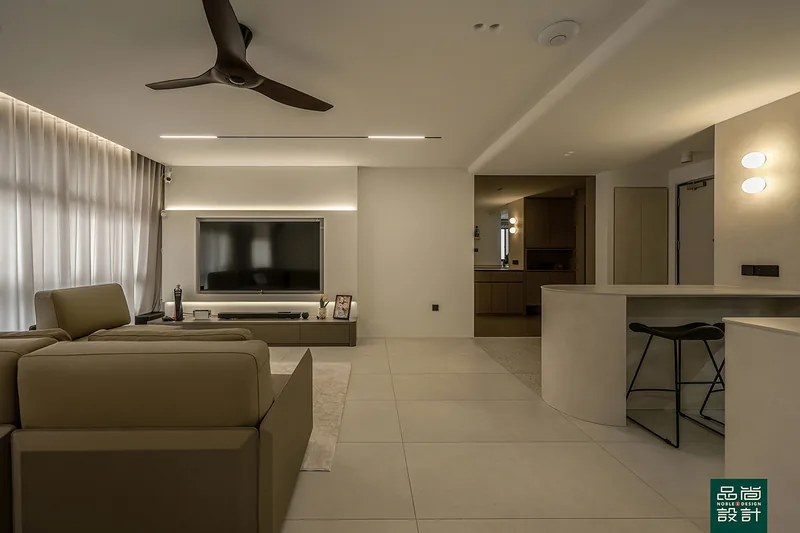
Pick by who carries the coordination risk, not by job title, because Singapore's renovation rules attach to the entity doing the works: a firm renovating an HDB flat must be listed in HDB's Directory of Renovation Contractors, and works whose plans need approval by the Commissioner of Building Control must be run by a licensed builder. A design-and-build firm sells one contract and owns the sequence between trades; a direct contractor executes a scope you have already fixed and prices tighter because nobody is coordinating for you. Choose the direct contractor when the scope is defined and visual, and the designer when the layout changes or trades overlap.
- What Singapore actually regulates, and what it does not
- Interior designer vs contractor in Singapore: the three delivery models
- Who signs what: permits, licensed trades and the paper trail
- The build sequence is what you are really buying
- Where the money risk sits in each model
- When the cheaper option is the right one
Interior designer, renovation contractor, main contractor: in Singapore these describe a commercial role, not a protected title. Anyone weighing interior designer vs contractor in Singapore is really choosing between three arrangements — a firm that designs and carries responsibility for the whole build, a firm that executes a scope you have already defined, or a licensed main contractor on works that need plan approval. Each arrangement moves the coordination risk to a different party, and the paperwork follows the risk.
What Singapore actually regulates, and what it does not
Singapore's renovation rules attach to the entity performing the works rather than to a job title. Nothing in HDB's contractor registry or BCA's builder licensing regime registers a person as an "interior designer"; those regimes register the contractor and the builder. Printing the title on a name card breaks no rule, while carrying out renovation works in an HDB flat through a firm that is not listed in HDB's Directory of Renovation Contractors does:
"You are responsible for the renovations in your flat and have to ensure that your contractor carries out all works in line with HDB guidelines. The Housing & Development (Renovation Control) Rules 2006 require that you only engage contractors from the Directory of Renovation Contractors to carry out renovations in your flat." — HDB, Important Information on Renovations
Engaging an unlisted firm is an offence under the Housing and Development (Renovation Control) Rules, which carry a fine not exceeding S$5,000. HDB separately runs a demerit point system for registered renovation contractors, under which a contractor accumulating 24 or more demerit points within 24 months is delisted from the Directory of Renovation Contractors. Listing is a floor with a trapdoor underneath it, not a quality ranking.
HDB's Directory is published as an open dataset, and its contents show how little listing proves. A query of the Directory of Renovation Contractors dataset on data.gov.sg returned 2,708 listed contractors on 9 August 2026, each record holding seven fields: UEN, directory reference number, company name, address, postal code, email address and contact number. No field in that dataset records design capability, project management, workmanship or delivery history.
Interior designer vs contractor in Singapore: the three delivery models
A design-and-build firm sells drawings plus a single contract for the whole build, then buys in the trades — hacking crew, tiler, carpenter, electrician, painter, aircon installer — under its own name. The homeowner signs once, chases one party, and pays for that coordination inside the build price. The failure mode is a firm that designs well and supervises thinly, so the drawings are handsome and the site runs on whichever subcontractor shouted loudest that morning.
A direct renovation contractor executes a scope the homeowner has already fixed: overlay the floor, replace the toilet suite, rewire the kitchen, build these four carpentry runs. Pricing is usually tighter because nobody is being paid to invent a layout or to sit on site resolving clashes. The failure mode is that unresolved decisions become the homeowner's problem mid-build, at the worst possible moment — the tiler is on site, the chosen tile is out of stock, and the carpenter's delivery slot is booked for Thursday.
Main contractor is the accurate description once works need statutory plan approval, which is the trigger for landed rebuilds and for structural alteration in private property. BCA is explicit about who needs a licence in that situation:
"You must obtain a builder's licence if you are a builder carrying out: Building works where plans require approval by the Commissioner of Building Control." — BCA, Builders Licensing Scheme
BCA also states that in general only main contractors are required to apply for a General Builder's Licence, and that all licensed builders are listed in the BCA e-directory. A homeowner reading a proposal for a landed rebuild should check that the licence appears in the e-directory under the name printed on the contract.
Who signs what: permits, licensed trades and the paper trail
Permit responsibility sits with the flat owner rather than the firm: "As the HDB flat owner, you are responsible for obtaining all HDB renovation permits required for your flat's renovations before renovation works begin." The HDB renovation guide on MyNiceHome adds that owners may authorise the renovation contractor to submit the application online on their behalf, and that layout plans, elevations, sections or details of the proposed works must be submitted with the application where fittings are removed or repositioned and where walls are hacked down or constructed.
Several trades are gated to specific accreditations no matter who won the job. HDB's renovation guide states that any air-conditioners must be installed by a BCA-trained air-conditioner installer, and that installing or replacing windows requires a BCA-approved window contractor listed in the HDB Directory of Renovation Contractors. A designer who cannot name the window contractor and the aircon installer on your job is not coordinating your job.
Working hours are set by HDB, and they constrain the programme far more than most quotations admit. General renovations such as plastering and laying floor screed are allowed 9am to 6pm Monday to Saturday and not allowed on Sundays and public holidays, while noisy renovations such as demolishing walls and removing wall or floor finishes are allowed 9am to 5pm Monday to Friday and not allowed on weekends, public holidays and the eve of major public holidays, per the HDB renovation guide. Hacking a BTO toilet is restricted further: owners of a newly built BTO flat have to wait 3 years before removing any wall or floor finishes in the toilets, so an overlay is the only lawful route in year one.
The build sequence is what you are really buying
Renovation goes wrong in the joints between trades, and the sequence is where a coordinator earns the fee. Electrical chasing and aircon pipework have to be set out before plastering closes the walls. The condensate drain has to fall continuously to its discharge point and be flow-tested before the false ceiling is boarded, because opening a finished ceiling to correct a back-flowing drain costs more than the drain. Wet-area waterproofing has to be laid and tested before screed and tile, with the membrane turned up the walls past the expected splash line and carried over the kerb and threshold.
Carpentry is measured last for a reason. Tile and adhesive, skim coat and levelling screed all move the finished faces of a room after the drawings were issued, so a carcass cut to drawing dimensions arrives with a gap at one end and a binding door at the other. A firm that templates carpentry after tiling and skim is describing how it runs a site; a firm that orders carpentry in week one has bought a scheduling win and sold you a scribe strip.
Substrate choices are another place where two identical-looking quotations diverge, because plywood, moisture-resistant board and aluminium behave differently under a sink and the difference does not appear for a year. Homeowners should also know what the newest material rule does not cover. From 1 January 2026 NEA requires interior paints sold in Singapore to contain no formaldehyde, with in-can content below 0.01% weight by weight — a paint rule that says nothing about the adhesives in composite wood carpentry, which is where most board emissions originate.
Where the money risk sits in each model
Prepayment is the specific risk that has hurt Singapore homeowners, and the numbers are public. CASE recorded 787 complaints against renovation contractors in 2025, down 18.2 per cent from 962 in 2024, with prepayment losses in that industry falling 73.8 per cent to $190,667 from $728,813.76 and renovation ranking second-highest of any industry for prepayment losses, according to the CASE media release of 9 February 2026. Deposit exposure scales with scope, so a single design-and-build contract concentrates more of a homeowner's cash with one counterparty than a series of direct trade contracts does.
CaseTrust accreditation caps that deposit exposure by contract. CaseTrust requires accredited renovation businesses to purchase a deposit performance bond safeguarding deposit payments against closure, winding up and liquidation, to adopt the CaseTrust Standard Renovation Contract, to collect payments in phases upon agreed milestones, to cap initial deposits at a maximum of 20% of the total cost, and to provide homeowners a workmanship warranty for 12 months from the completion date of the works. Noble Interior Design Pte. Ltd. is listed in HDB's Directory of Renovation Contractors (DRC Ref: HB-12-5230A, UEN 201722629H) and is CaseTrust-accredited.
Design fees are the honest place to compare models, because a design-and-build price bundles work that a direct contract leaves the homeowner to do.
When the cheaper option is the right one
A direct contractor is usually the better buy where the scope is fixed and visual: an overlay refresh, a like-for-like toilet replacement, rewiring, repainting, or replacing carpentry within an existing layout. Nobody needs to be paid to design a decision already made, and a homeowner can supervise one trade at a time.
A designer or a design-and-build contract earns its keep when the layout changes, when trades overlap, when the flat is occupied during works, or when the programme is tight against a move-in date. Hacking, wet works, carpentry and air-conditioning on one floor plate generate dozens of clash decisions, and the cost of a wrong one — a drain regraded after tiling, a carcass rebuilt because a wall moved — is generally larger than the coordination fee that would have prevented it.
One question settles the choice for most homeowners. Ask each firm who will be on site the morning the tiler and the carpenter disagree, and ask for that person's name and phone number in the contract. A firm that can answer is selling coordination; a firm that cannot is selling drawings, and the coordination will be yours.
- HDB — Important Information on Renovations
- Housing and Development (Renovation Control) Rules, Singapore Statutes Online
- HDB — Directory of Renovation Contractors
- HDB Directory of Renovation Contractors, open dataset on data.gov.sg
- HDB renovation guide (MyNiceHome)
- BCA — Builders Licensing Scheme
- BCA e-directory of licensed builders
- CASE media release, 9 February 2026
- CASE — CaseTrust accreditation for renovation businesses
- NEA — No formaldehyde in interior paints from 1 January 2026
Tell us the flat and when you get the keys.
You will get a written quotation with every line spelled out. Take it and compare it with anyone.
Get a quote